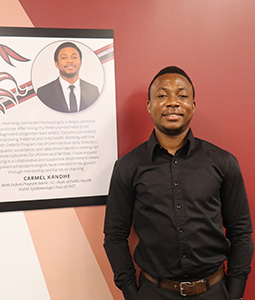
Carmel Kandhe Turns Personal Experience Into a Passion for Public Health
When Carmel Kandhe began his journey in public health, he already had experience working in healthcare. After earning a degree in pharmaceutical sciences in the Democratic Republic of Congo, where he grew up, he worked as a pharmacist. However, an experience working on a public health project during an outbreak in Kenya changed the way he thought about his career.
While working on the project, Kandhe began to realize that he wanted to do more than treat individual patients. He wanted to understand how healthcare challenges affect entire communities and how research could help prevent disease before people became sick.
“I realized I can do more,” he said. “I prefer to be at the front line and doing things where I can help people in the population a little bit.”
That realization ultimately led him to pursue further education in public health at the University of South Carolina, where he has continued to build his research experience, professional network and understanding of how public health knowledge can be applied beyond the classroom. For Kandhe, however, his interest in prevention is also deeply personal.
Growing up in a rural area, he witnessed the challenges people faced when trying to access healthcare. One of the experiences that shaped his perspective was losing a close family member when she was just three years old because of birth defects that had not been detected early enough. Although his family did everything they could, she passed away. The experience stayed with him and influenced the kind of impact he wanted to make through his career.
“If we can't access a strong health system, we can at least prevent what makes us sick,” he said.
That experience motivated Kandhe to learn more about birth defects and the factors that can affect a child's health before and during pregnancy. He became interested in understanding how medication, environmental exposures and other factors can influence birth outcomes, as well as how research can help prevent similar cases in the future. With his background in pharmacy, Kandhe understood the importance of treatment. However, he also recognized that medication can be expensive and inaccessible for many people.
“I want to do things that can help people to prevent getting sick, then waiting for them to come to take medication,” he said.
As he began studying public health, he wanted to find a way to connect what he was learning in the classroom with the challenges people face in their everyday lives. Gaining hands-on experience became an important step toward that goal.
When Kandhe arrived at USC as an international student, adjusting to a new country and educational system presented its own challenges. Originally from a French-speaking country, he had to adapt to an English-speaking academic environment while navigating a large university. He also arrived two weeks after classes had started because of visa challenges, missing orientation and struggling to find his way around campus.
“I was so lost,” he said, recalling his first days at USC.
Rather than allowing those challenges to keep him from getting involved, Kandhe began actively searching for resources and opportunities. He attended internship fairs, connected with other students and explored the services available through the university. He knew that earning good grades was important, but he wanted his education to extend beyond the classroom.
“I can be good in the classroom, but that is not enough for me,” he said. “I should do more than that.”
As he learned more about USC, Kandhe began building relationships with faculty members and seeking opportunities to gain research experience. He reached out to more than 20 faculty members before one offered him a position. That connection eventually opened the door to additional opportunities, reinforcing the importance of persistence and communication in his professional development. His approach also helped him identify an opportunity at the South Carolina Department of Public Health.
During the spring semester, Kandhe contacted a faculty member and explained that he was interested in gaining internship experience with the department. Because the faculty member had previously worked there, he was able to connect Kandhe with someone in his professional network.
Through that introduction, Kandhe began exploring an opportunity to gain research experience. He then reached out directly to the department's birth defects office to ask about completing an internship over the summer. The position was not initially advertised as an open internship opportunity, but Kandhe took the initiative to ask whether he could get involved. The department offered him an opportunity, allowing him to pursue the experience he had been looking for.
As he learned more about the university's resources, Kandhe also discovered the South Carolina Internship Program (SCIP), which provides funding support for eligible students completing internships. After confirming that he met the requirements, he applied and was approved for the program. The funding helped make it possible for him to participate in the internship while continuing to navigate the requirements associated with completing an internship as an international student.
For Kandhe, the experience at the South Carolina Department of Public Health became an opportunity to apply his academic knowledge to real-world challenges. Working in the birth defects office, he analyzed population survey data to better understand patterns related to pregnancy, environmental exposures and birth outcomes. Rather than studying public health concepts only in an academic setting, he could begin to see how data could be used to identify problems affecting communities and inform decisions about prevention.
“I learned how to transfer my knowledge in the classroom to real life,” he said.
The internship also changed the way he understood research. He began to recognize that collecting and analyzing data was only part of the process. The information had to be used to help address public health challenges, inform policy and support decisions that could improve people's lives.
“Data is not just because we want to do analysis,” he said. “We should use data as evidence to inform things that we change.”
The experience also taught him lessons that extended beyond research. Kandhe learned the importance of professional communication, collaboration, punctuality and being willing to acknowledge what he did not know. He realized that an internship was not simply an opportunity to demonstrate what he had learned in class. It was also a chance to recognize gaps in his knowledge, ask questions and develop new skills.
“You should recognize that an internship is not only something that you are going to prove what you're learning in the classroom, but you should be flexible to learn things that you don't know,” he said.
Through the internship, Kandhe also established a professional relationship with his supervisor and expanded the network he had been building since arriving at USC. Those connections have become an important part of his preparation for the next stage of his career.
His growing involvement at USC has also created opportunities to support other students. Kandhe was nominated to participate in a national leadership society and became vice president of the dean's student advisory group in his school. In that role, he hopes to help students understand the resources available to them and make the transition into university life easier, particularly for international students who may not know where to find support.
Having experienced the difficulties of adjusting to a new environment himself, Kandhe understands how challenging it can be to navigate a university without knowing which questions to ask or where to turn for help. He believes students can benefit from taking an active role in finding information, connecting with faculty and exploring opportunities they might not otherwise discover.
His advice to other USC students is simple. Be proactive.
“If you are not proactive, you will feel like there is no opportunity and that there is not something for you,” he said.
He encourages students to seek out opportunities even when they do not see an advertised position, ask questions when they are unsure about requirements and continue reaching out even after facing rejection. For Kandhe, persistence has been essential to his growth. From contacting faculty members to pursuing an internship that was not initially advertised, he has learned that students cannot always wait for opportunities to come to them.
“The worst they can say is no,” he said.
Looking ahead, Kandhe hopes to become an independent public health researcher. He is currently pursuing a master's degree and plans to continue his education through a Ph.D. program, where he can develop the research skills needed to make a broader impact. Ultimately, he wants his work to connect scientific research with the needs of communities, helping translate what researchers learn into practical solutions that can prevent disease and improve access to healthcare.
He also hopes to return to the Democratic Republic of Congo and use the knowledge and experience he gains in the United States to strengthen public health efforts in his home country. He continues to work with his school back home as a research assistant in the department of pharmacy, where he helps train students in research. For Kandhe, success means more than advancing his own career. He wants to help future generations of public health professionals gain the knowledge, mentorship and opportunities they need to make a difference.
Looking back, the experiences that brought him to USC and led him to the South Carolina Department of Public Health have reinforced his belief that challenges can become opportunities for growth. Through persistence, professional connections and a willingness to seek out new experiences, he has continued moving toward a career centered on prevention and community impact. His journey demonstrates that career development does not always follow a predetermined path. Sometimes, it begins with a personal experience, a conversation with a faculty member or the decision to ask for an opportunity that does not yet exist.
For Kandhe, each of those steps has brought him closer to his goal of making public health research meaningful beyond the classroom and using what he learns to help communities build healthier futures.